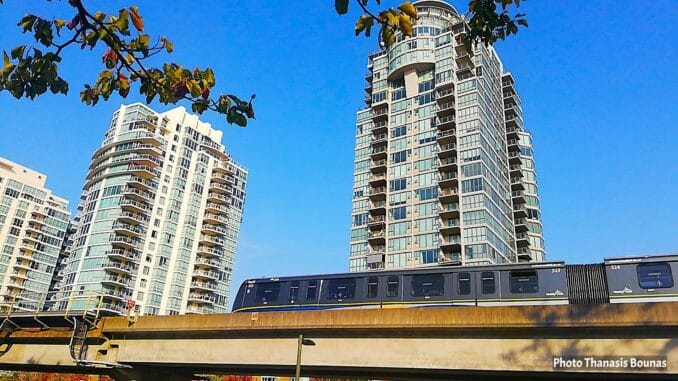
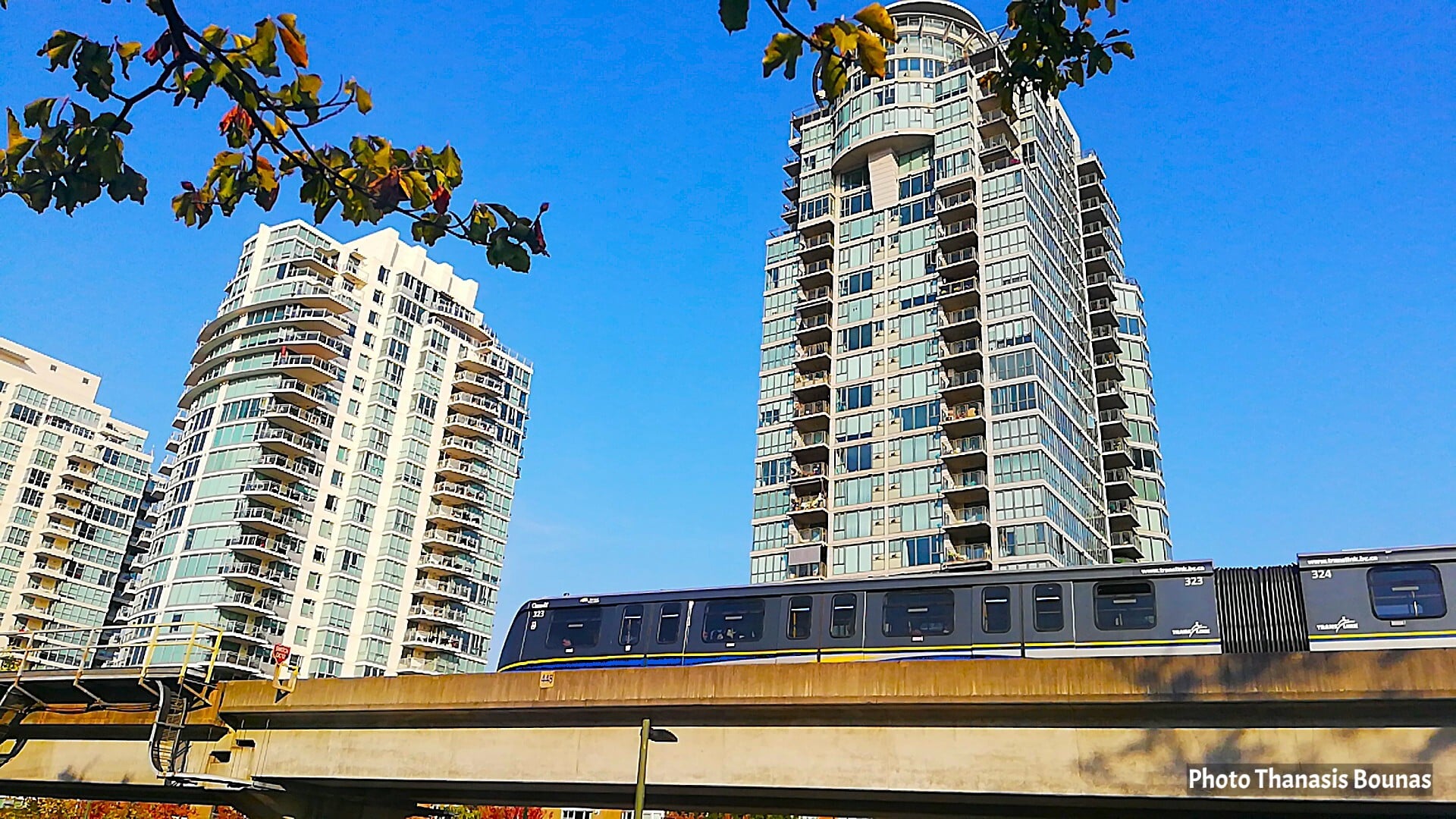
Travelling through Vancouver on the SkyTrain offers more than a convenient way to move across the city. From its elevated tracks, passengers can discover a changing landscape of modern buildings, historic neighbourhoods, waterways, and mountains.
One of the most memorable views appears near False Creek, where the distinctive geodesic dome of Science World rises beside the waterfront. As the train passes through this part of Vancouver, the city reveals a remarkable connection between its transportation history and its urban transformation.
The SkyTrain is not simply a railway system. It is part of the story of how Vancouver developed into one of Canada‘s major Pacific cities.
Vancouver SkyTrain Ride | Scenic City Views from the Train
The Birth of Vancouver’s SkyTrain
The history of Vancouver’s SkyTrain began in the early 1980s, when British Columbia was preparing to welcome visitors from around the world for Expo 86.
The international exhibition, held in Vancouver in 1986, focused on transportation and communication. It created an opportunity for the city to introduce a new form of urban transportation.
On December 11, 1985, the SkyTrain opened for a short period of free public service. Regular passenger operations began in January 1986.
Its original route, known as the Expo Line, connected Vancouver with New Westminster.
The system was remarkable for its automated operation. Unlike conventional railways, SkyTrain trains operate without drivers, using computerized technology to control their movements.
Much of the original railway was constructed above street level, allowing passengers to enjoy views of the surrounding city while travelling.
The elevated design also helped separate trains from road traffic, making the system an important step in the modernization of Metro Vancouver’s transportation network.
Science World and the Legacy of Expo 86
One of the most recognizable landmarks visible from the SkyTrain is Science World, located at the eastern end of False Creek.
Its enormous geodesic dome was originally constructed as the Expo Centre for the 1986 World’s Fair.
Designed by architect Bruno Freschi, the building became one of the exhibition’s most recognizable structures.
Expo 86 opened on May 2, 1986, and continued until October 13 of the same year. More than 22 million visits were recorded during the international event.
Although the dome had originally been intended as a temporary exhibition building, it survived after the fair ended.
It was subsequently transformed into Science World, a permanent educational centre dedicated to science and technology.
Today, its unusual geometric architecture remains one of Vancouver’s best-known landmarks.
Seeing the dome from the SkyTrain provides a direct visual connection to the period when Vancouver was preparing to present itself to the world as a modern international city.
False Creek – From Industrial Waterfront to Modern Vancouver
The landscape surrounding Science World has changed dramatically over the decades.
Before the transformation associated with Expo 86, much of the northern shoreline of False Creek was occupied by railway infrastructure, industrial buildings, warehouses, and other commercial activities.
The waterfront played an important role in Vancouver’s industrial economy.
Railways connected the area with the wider transportation network, while the surrounding waterways supported maritime activities.
During preparations for Expo 86, large sections of the former industrial lands were redeveloped into exhibition grounds.
The event became a turning point in the area’s history.
After the exhibition, the surrounding land gradually evolved into residential neighbourhoods, public spaces, parks, and waterfront walkways.
Today, the False Creek shoreline offers a very different landscape from the industrial environment that once dominated the area.
Modern residential towers stand beside pedestrian pathways, while boats and small ferries move across the water.
From the windows of the SkyTrain, this transformation becomes part of the journey.
Travelling Past Main Street–Science World Station
The Main Street–Science World Station is one of the most interesting points along Vancouver’s original Expo Line.
Located near Main Street and Terminal Avenue, the station provides access to Science World and the eastern end of False Creek.
Nearby is Pacific Central Station, an important transportation terminal serving intercity rail and bus passengers.
The location brings together several different forms of transportation within a relatively small area.
From the elevated railway, passengers can observe the waterfront, surrounding streets, and the distinctive architecture of Science World.
The changing perspective creates an unusual experience.
At one moment, the train passes through a dense urban environment. A few seconds later, the view opens toward the water, revealing boats, buildings, and the distant skyline.
For visitors interested in photography or urban landscapes, the journey offers opportunities to observe Vancouver from a perspective that is difficult to experience at street level.
Watching Vancouver Change from the Train
One of the most fascinating aspects of travelling on the SkyTrain is the contrast between Vancouver’s older infrastructure and its modern development.
Railway lines, bridges, and industrial areas remain visible in different parts of the city, even as new residential and commercial districts continue to grow.
At sunset, the experience becomes particularly atmospheric.
The evening light reflects from the windows of buildings, while the water of False Creek takes on softer colours.
The silhouettes of the skyline gradually emerge against the changing sky.
From the train, these scenes pass quickly, offering brief impressions of a city constantly in motion.
For travellers exploring British Columbia, the SkyTrain provides an opportunity to experience the everyday rhythm of Metro Vancouver while discovering its urban history.
The journey also illustrates how transportation infrastructure can influence the growth and character of a city.
What began as an ambitious project connected to Expo 86 has become an essential part of life in the region.
And near Science World, where the railway passes beside False Creek, the history of Vancouver’s transportation system and the transformation of its waterfront can still be seen together.
Be the first to comment