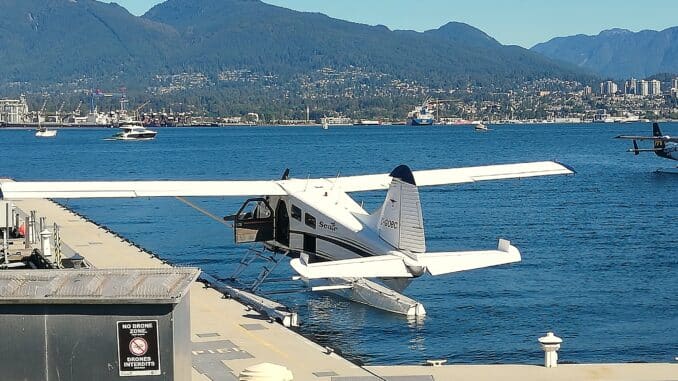
There is a moment along the coast of British Columbia when an aircraft looks as though it belongs to the sea.
Its floats rest on the water. The wings stretch above the harbor, and the surrounding boats seem to share the same world.
It is an unusual sight, yet in this part of Canada, floatplanes have become a familiar feature of coastal life.
They represent something special about British Columbia: a place where the ocean, the mountains and the sky are closely connected.
Seaplane in British Columbia | Flying Over Canada’s Pacific Coast
The Beauty of Floatplanes on the Pacific Coast
Watching a floatplane from the waterfront offers a different perspective on aviation.
At an ordinary airport, aircraft move along runways surrounded by terminals and taxiways. Here, the water becomes the surface from which a journey begins.
The aircraft rests gently on its floats while the movement of the sea continues beneath it.
Nearby, sailboats and motor vessels may be moving through the harbor. In the distance, the mountains and coastal landscape form a natural backdrop.
There is a quiet fascination in this combination of aviation and maritime life.
For photographers and travelers, even a stationary floatplane can become a memorable part of the scenery.
Vancouver and Its Waterfront Aviation Culture
Vancouver is one of the best-known places in British Columbia to experience the region’s seaplane culture.
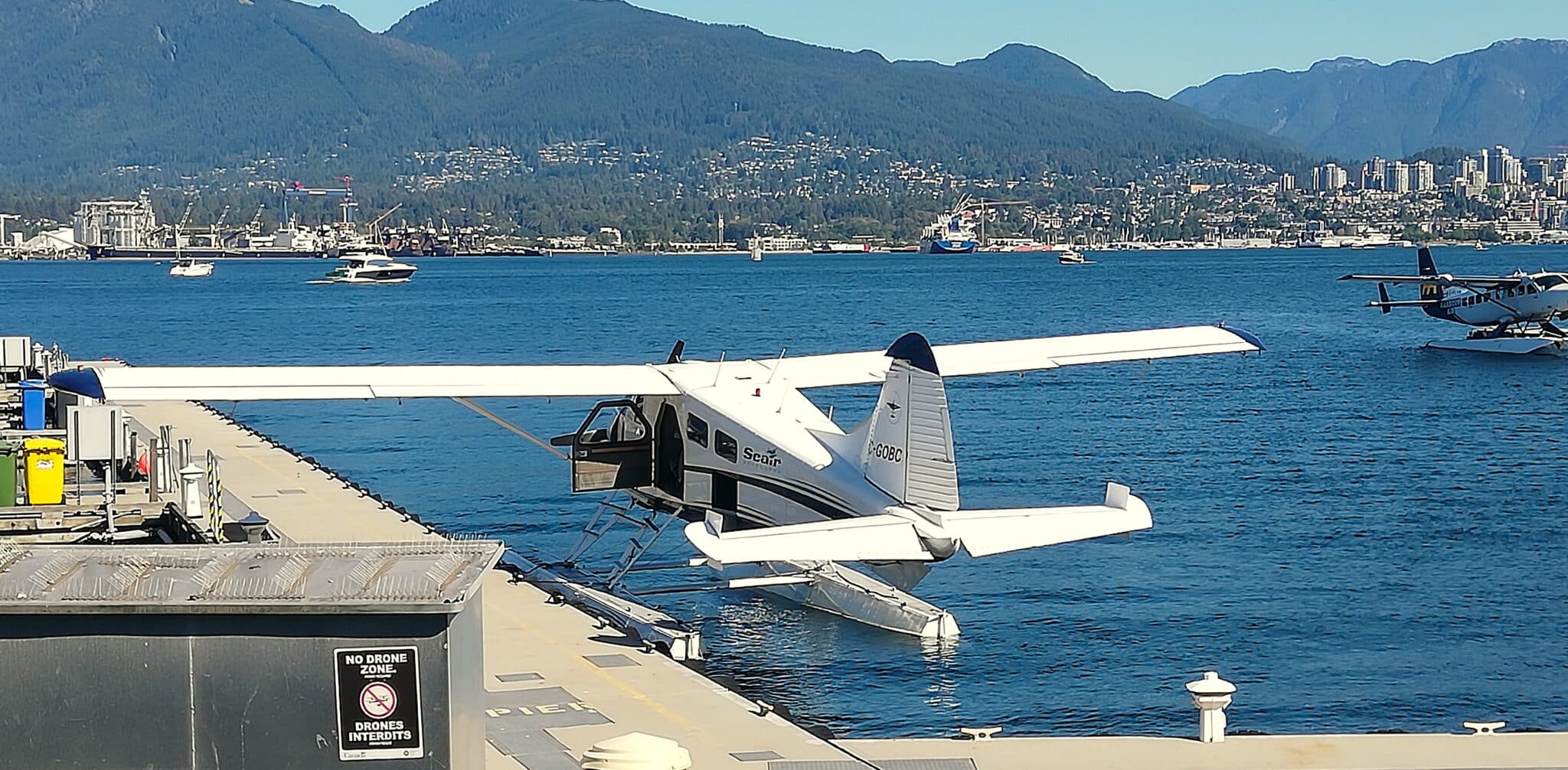
Along the waterfront near Canada Place and Coal Harbour, aircraft operate in an environment surrounded by the city’s skyline, mountains and the waters of Burrard Inlet.
The sight of a floatplane preparing to depart is particularly distinctive.
It moves across the water rather than a conventional runway, gradually gathering speed before lifting into the air.
For visitors walking along the waterfront, this activity reveals a side of Vancouver that is closely connected to the geography of Canada’s Pacific coast.
The city is not simply built beside the ocean.
Its waterways are part of the way people travel and experience the region.
A Coastline That Makes Water Travel Essential
British Columbia is a landscape of islands, inlets, forests and mountains.
Vancouver Island lies across the Strait of Georgia from the mainland, while numerous smaller islands are scattered throughout the coastal waters.
Some communities are connected by highways and ferries. Others depend on aircraft or marine transportation for more convenient access.
Floatplanes are especially suited to this environment because they can operate from suitable waterways.
They make it possible to connect places separated by water and difficult terrain without requiring conventional airport infrastructure at every destination.
What may appear unusual to visitors is therefore part of a practical transportation system.
From Vancouver to the Coastal Islands
The experience of British Columbia changes when the coastline is viewed as a connected maritime landscape.
Vancouver, Victoria and the Gulf Islands are linked by a network of sea and air routes.
From the waterfront, it is easy to imagine the journeys that begin as an aircraft leaves the harbor.
Beyond the city lie forested islands, narrow channels and coastal settlements that reveal another side of Canada.
The same connection with the sea can be experienced in places such as False Creek, Granville Island and Steveston, where boats, marinas and working waterfronts remain part of everyday life.
At White Rock, farther south, the coastal landscape opens toward Semiahmoo Bay and the international border.
These places are different, yet they share an identity shaped by the Pacific coast.
The Freedom of Water and Sky
For someone who enjoys sailing, watching a floatplane has a particular attraction.
A sailboat moves with the wind and water, while an aircraft uses its wings and engine to travel above the landscape.
Their methods are different, but both offer the possibility of seeing familiar places from a new perspective.
The coastline becomes a route rather than a boundary.
Islands become destinations waiting beyond the horizon.
And the journey itself becomes part of the experience.
This is what makes floatplanes such a distinctive part of British Columbia.
They belong to the water when they are resting in the harbor and to the sky when their journey begins.
Between those two worlds lies the extraordinary geography of Canada’s Pacific coast.
Be the first to comment